Jobs in Microsoft Dynamics 365 CRM: Roles, Skills and How to Get Hired
The main Dynamics 365 CRM roles, the skills employers want, current certifications and how to find full-time, contract and freelance work.
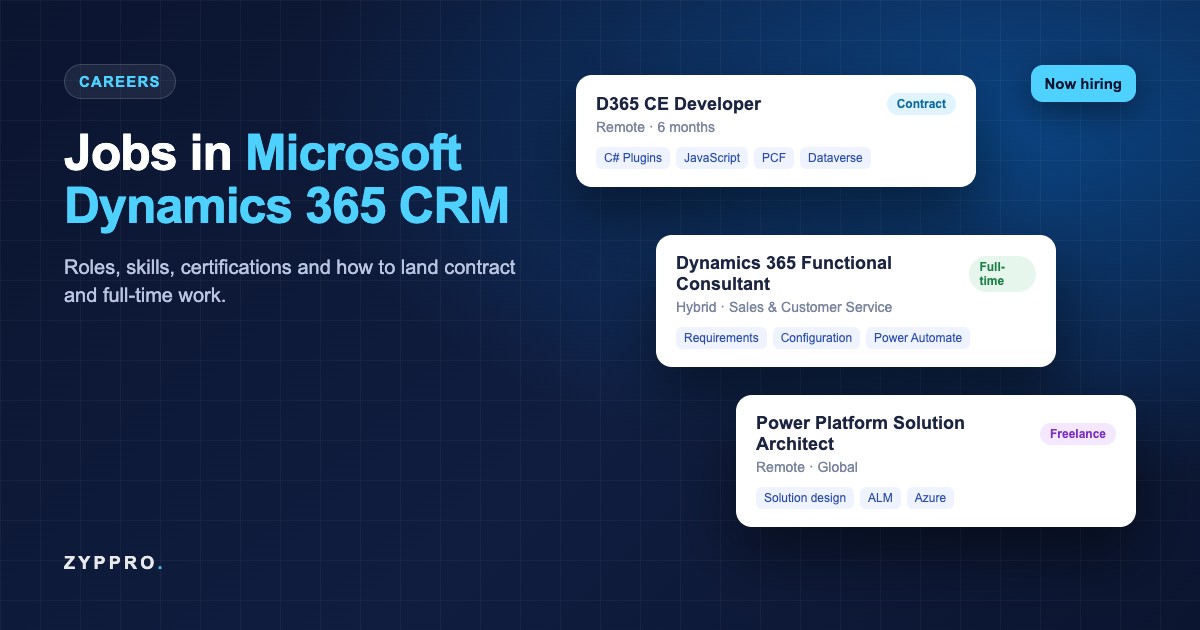
Microsoft Dynamics 365 CRM (also called Dynamics 365 Customer Engagement) is used by thousands of organisations for sales, customer service, field service and marketing. Every one of those implementations needs people to design, build, integrate and support it. That makes Dynamics CRM one of the most stable and well-paid niches in the Microsoft ecosystem, and one where contract and remote work are common.
This guide explains the main roles, the skills employers look for, which certifications matter today, and how to get your first (or next) Dynamics 365 CRM job.
What "Dynamics 365 CRM" covers
When recruiters say Dynamics CRM, they usually mean the customer-facing apps built on Dataverse:
- Dynamics 365 Sales: leads, opportunities, quotes, forecasting
- Dynamics 365 Customer Service: cases, queues, SLAs, knowledge base, omnichannel
- Dynamics 365 Field Service: work orders, scheduling, technicians, assets
- Dynamics 365 Customer Insights: customer data and marketing journeys
Because these apps run on the Power Platform, almost every CRM role also involves Power Apps, Power Automate and Power BI.
The main roles
1. Dynamics 365 CE Developer
Extends the platform with code. Typical work: C# plugins and custom workflow activities, JavaScript form scripts, PCF controls, custom APIs, integrations through the Dataverse Web API and Azure Functions. Key skills: C#, .NET, JavaScript/TypeScript, Dataverse event pipeline, FetchXML, solution management.
2. Functional Consultant
Translates business requirements into configuration: entities and fields, forms and views, business rules, security roles, business process flows and Power Automate flows. Runs workshops and user training. Key skills: process analysis, Dynamics configuration, communication, documentation.
3. Technical Consultant / Integration Specialist
Connects Dynamics to ERP, websites, telephony and data platforms using Azure Logic Apps, Service Bus, Data Factory, SSIS with KingswaySoft or middleware. Key skills: APIs, Azure integration services, data migration.
4. Power Platform Developer
Builds canvas and model-driven Power Apps, Power Pages portals, automation and Copilot Studio agents on top of Dataverse. Key skills: Power Fx, Power Automate, Dataverse design, ALM.
5. Solution Architect
Owns the overall design: data model, security, integrations, environment strategy and ALM. Usually requires several years of hands-on delivery.
6. Support and Administration
Manages environments, users, licences, deployments and day-to-day issues. A common entry point into the Dynamics world.
Skills that make you stand out
- Solid Dataverse fundamentals: tables, relationships, security model and business units.
- ALM: managed solutions, environment variables, connection references and pipelines in Azure DevOps, GitHub or Power Platform pipelines.
- Integration experience: even one real integration project lifts your profile a lot.
- AI and Copilot features: Copilot Studio and Copilot in Dynamics 365 are now part of many projects.
- Communication: contract roles in particular value people who can work directly with clients.
Certifications in 2026
Microsoft has reshaped its certification portfolio this year, and several familiar exams (including PL-200, PL-600 and MB-280) have retired. Newer "AB" exams are replacing some of them. Currently useful options include:
- PL-900 – Power Platform Fundamentals (a good starting point)
- MB-230 – Dynamics 365 Customer Service Functional Consultant
- AB-210 – the newer path for Sales and customer experience roles
- AB-410 – the newer path for Power Platform functional consultants
- AB-400 – the new developer exam that replaces PL-400
Exam availability changes often. Always confirm the current list on Microsoft Learn before you book.
Certifications help you pass CV screening, but hiring managers care more about what you have built.
Full-time, contract or freelance?
- Full-time roles at partners and end-user companies offer training and variety.
- Contract roles (often 3–12 months) pay a premium for people who can deliver quickly. Many are remote, and demand is strong in the UK, the US, the Middle East, Europe and India.
- Freelance and job support work suits experienced specialists who help teams with specific problems.
How to get hired
- Build a demo environment. A free developer environment lets you build a small CRM solution: a custom table, a plugin, a PCF control and a Power Automate flow.
- Show your work. Share it on GitHub or LinkedIn, with screenshots and a short write-up.
- Tailor your CV to the module. "Field Service scheduling and work order automation" beats "Dynamics 365 experience".
- Follow recruiter posts on LinkedIn. Many Dynamics contract roles are posted there first, often with a direct email address.
- Prepare for technical interviews. Expect questions on the plugin pipeline, security roles, ALM and real project situations.
How Zyppro can help
Zyppro Technologies works with Dynamics 365 CRM and Power Platform professionals on contract and project roles for clients worldwide. We also provide live job support for developers and consultants who need an expert alongside them on a live project, and we are preparing a hands-on Dynamics 365 CE developer course.
Visit www.zyppro.com or email contact@zyppro.com to find out more.