How AI Is Transforming Enterprise Workflows
From document processing to decision support, AI is reshaping how enterprises work. Here's what's changing and how to adopt it the right way.
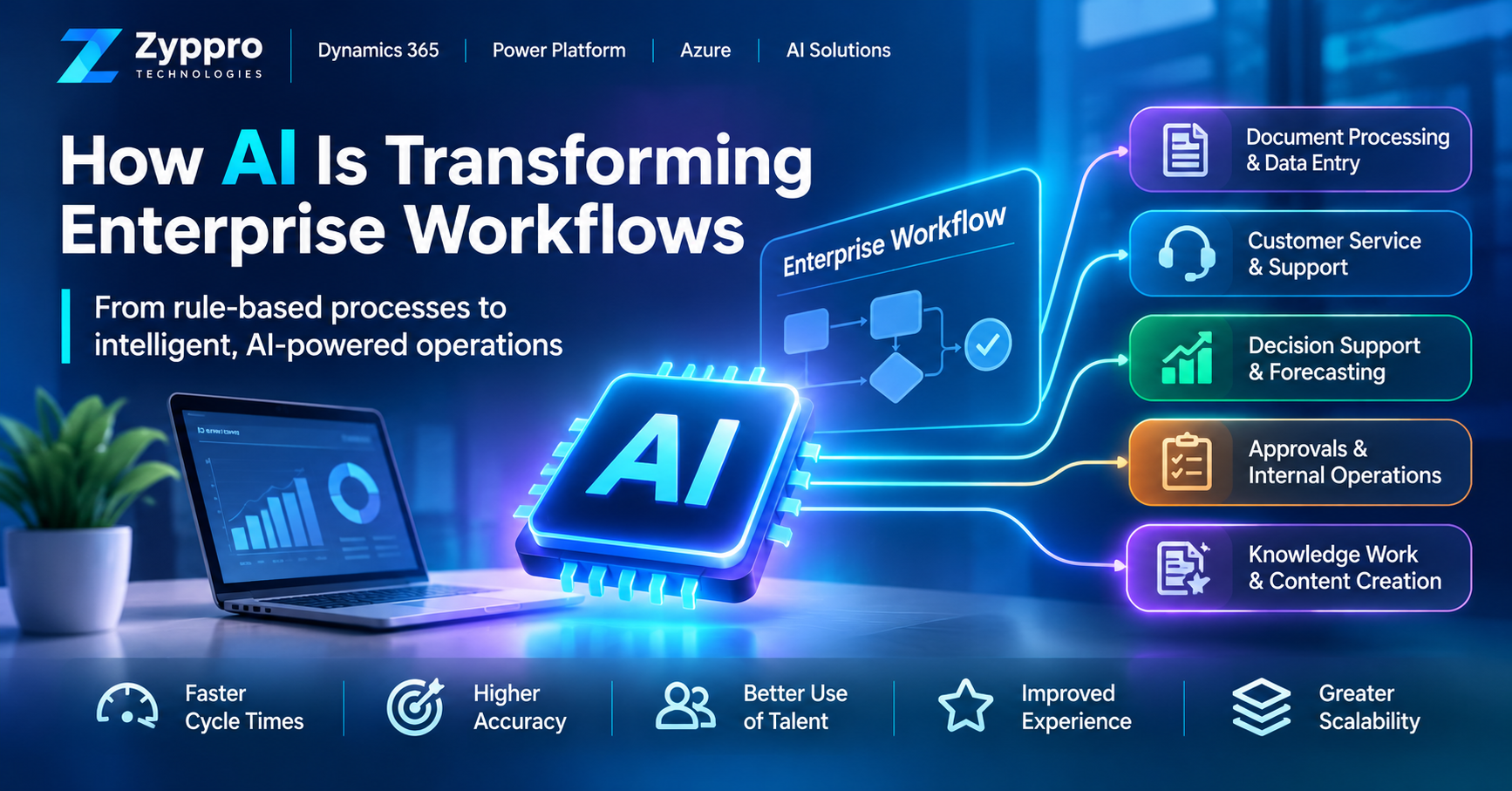
How AI Is Transforming Enterprise Workflows
For years, enterprise efficiency meant digitising paper forms, moving data into central systems, and writing rules to route work from one team to the next. That approach delivered real gains, but it also hit a ceiling. Rule-based systems struggle with unstructured information, exceptions, and judgement calls, which is exactly where most of the time in a business process gets spent.
Artificial intelligence is changing that. Today, AI in enterprise workflows is no longer an experimental add-on. It is becoming the layer that reads documents, understands requests, predicts outcomes, and hands people the information they need at the moment they need it. In this article, we look at where AI is making the biggest difference, what it takes to adopt it responsibly, and how organisations can get started.
From Rule-Based Automation to Intelligent Automation
Traditional automation follows instructions: if this field equals X, send it to team Y. It works well when inputs are clean and predictable. The trouble is that real business inputs rarely are. Invoices arrive in dozens of layouts, customer emails mix several requests in one message, and approvals depend on context that no simple rule captures.
Intelligent automation combines workflow tools with AI capabilities such as natural language processing, document understanding, and machine learning. Instead of only following rules, the system can interpret content, classify it, extract the important details, and decide on the next step, escalating to a person only when confidence is low. The result is automation that covers far more of the process, not just the tidy parts.
Where AI Is Making the Biggest Impact
1. Document Processing and Data Entry
Purchase orders, contracts, delivery notes, and application forms still consume enormous amounts of manual effort. AI-powered document processing can read these files, pull out key fields, validate them against existing records, and push the data straight into ERP or CRM systems. Teams move from typing data to reviewing exceptions.
2. Customer Service and Support
AI assistants and chatbots now handle routine enquiries around the clock, answer questions from a company's own knowledge base, and route complex cases to the right agent with a summary already attached. Support teams spend less time on repetitive tickets and more time on conversations that genuinely need a human.
3. Decision Support and Forecasting
Machine learning models can analyse historical data to forecast demand, flag at-risk customers, predict maintenance needs, or highlight unusual transactions. Rather than replacing managers, these insights give them earlier warnings and better evidence for the decisions they already make.
4. Approvals and Internal Operations
Many internal workflows, such as leave requests, expense claims, procurement approvals, and official letter generation, involve gathering information, checking it against policy, and routing it for sign-off. AI can pre-check submissions, draft documents, summarise the request for approvers, and keep the process moving without constant follow-up.
5. Knowledge Work and Content Creation
Generative AI helps employees draft emails, summarise long reports, prepare meeting notes, and search across scattered company documents in plain language. Used well, it removes the blank-page problem and shortens the time between a question and a usable answer.
The Business Benefits
When AI is applied thoughtfully to workflows, organisations typically see:
- Faster cycle times, as work no longer waits in queues for manual handling.
- Higher accuracy, with fewer re-keying errors and more consistent policy checks.
- Better use of talent, as skilled employees shift from repetitive tasks to higher-value work.
- Improved customer and employee experience, thanks to quicker responses and less friction.
- Scalability, allowing volume to grow without a matching rise in headcount.
Challenges to Plan For
AI adoption is not simply a matter of switching on a new tool. Successful projects account for a few common challenges:
- Data quality: AI is only as reliable as the data it learns from and works with. Cleaning and connecting data sources is often the first real task.
- Security and governance: Sensitive business data must be protected, access must be controlled, and AI outputs should be auditable.
- Human oversight: High-impact decisions should keep a person in the loop, especially in early stages.
- Change management: Employees need training and clarity on how AI supports their roles rather than threatening them.
- Integration: AI delivers the most value when it is embedded into existing systems such as Microsoft 365, Dynamics 365, or line-of-business applications, not bolted on as a separate island.
How to Get Started
The most effective AI journeys start small and focused:
- Identify a high-volume, rules-heavy process with clear pain points, such as invoice handling or support triage.
- Map the current workflow and measure baseline metrics like processing time and error rates.
- Choose the right platform, for example Microsoft Power Platform, Azure AI services, or a custom solution, based on your existing ecosystem.
- Run a pilot, keep humans reviewing outputs, and refine the model and rules.
- Scale gradually, reusing components and governance practices across new processes.
Conclusion
AI is transforming enterprise workflows by taking on the work that rules alone could never handle: reading, interpreting, predicting, and assisting. The organisations seeing the strongest results are not those chasing every new tool, but those applying AI to clearly defined processes, with good data, sound governance, and people kept firmly at the centre.
At Zyppro Technologies, we help businesses design and implement intelligent automation across Microsoft Business Solutions, Azure, and custom software. If you are exploring where AI could streamline your operations, our team can help you identify the right starting point and build a solution that scales with your business.